
We all think we know the story of Bradley Stoke, Stoke Gifford and Little Stoke, but do we really? Bradley Stoke Voice takes a look back at how we got to where we are today.
Stoke Gifford
The origins of Stoke Gifford stretch back many centuries. The name Stoke Gifford reflects its historic identity, because the word ‘Stoke’ derives from Old English ‘stoc/stoche’ meaning a place of settlement or a dependent farmstead, pointing to its agrarian roots.
For a long time, Stoke Gifford remained a small rural village, centred around its church, village green, the old school and a scattering of cottages and farms. Over the centuries, the parish included hamlets and farms such as what later became Little Stoke, as well as broad swathes of farmland and woodland.
Significant change began in the 19th and 20th centuries when the arrival of the railway severed parts of the old village and changed the layout of settlement.
Little Stoke
Little Stoke began as a hamlet with farms and cottages, farming livestock and crops, with barns and fields. One of its oldest barns was already standing by 1725, despite belonging to a modest smallholding of only 23 acres, an indicator that farming in the area might have been cooperative, using shared barns or cider‑mills.
Over time, especially by the mid‑1800s, farms consolidated and by 1856, a large farm under tenant Benjamin Willcox encompassed hundreds of acres, incorporating much of the old farmland.
After World War II, Little Stoke began to change more fundamentally with the building of many council houses and prefabricated homes, reflecting broader post‑war demand for housing.
This marked the beginning of the shift from rural farmland to suburban housing estate.
By the early-to-mid 20th century, Little Stoke was transforming: the small rural village was rapidly becoming a more densely inhabited residential area.
Bradley Stoke
By the late 20th century, pressures from Bristol’s growth, demand for housing and the need for planned suburban expansion converged. That ultimately led to the creation of Bradley Stoke
Although the land belonged partly to Stoke Gifford parish (and partly to other neighbouring parishes), its transformation began in earnest in the 1980s. The name ‘Bradley Stoke’ was chosen in 1984, referring to the local streams: Bradley Brook and Stoke Brook which flow through the area.
In March 1987, the first turf was cut by local MP John Cope, using a JCB excavator: a symbolic start to construction. From 1988 onwards, the area that had once been farmland, woods, scattered farms and pastures began to be laid out as a large new development: more than 1,000 acres, of which roughly 650 acres were earmarked for housing, plus land for employment, open space, leisure, schools and facilities.
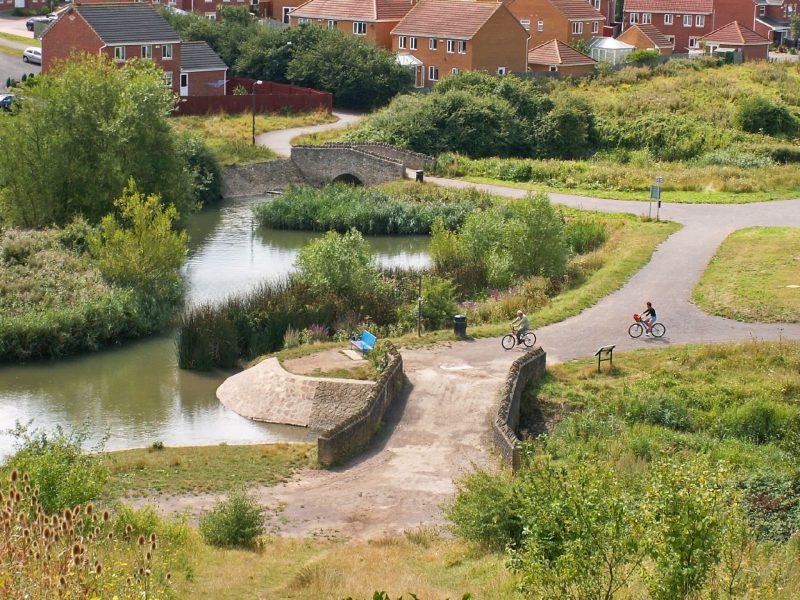
Alongside the new buildings, the area retained plenty of natural features from its rural past, such as woods and the Three Brooks, and despite initial ambitions for community and amenity‑rich design, early challenges emerged.
During the early 1990s’ recession, property values dropped sharply, many new homes went into negative equity, and the settlement gained a reputation as lacking soul, derisively and unfortunately nicknamed ‘Sadly Broke’.
Nonetheless, over time, Bradley Stoke grew into a sizable community. By 2011, there were more than 8,600 homes, with a population approaching 21,000. Over the years, residential development has been complemented by schools, shops (such as the Willow Brook Centre), leisure facilities and beautiful green spaces.
As Bradley Stoke expanded, it began to physically and socially envelop parts of what had been the older parish communities of Stoke Gifford and Little Stoke. The historic rural parish boundaries blurred.
Indeed, two‑thirds of Bradley Stoke lies within the parish of Stoke Gifford.
Meanwhile, Little Stoke, once its own tiny cluster of farms, effectively became a suburb within greater Stoke Gifford parish, sandwiched between older village settlements and
new suburban sprawl.
Today, while traces of the old (some barns, historic lanes, woods, brooks) still remain, residents experience a very different landscape: suburban housing estates, commuter routes and a blend of old village‑esque and 1980s/1990s new‑town design.
Continuity and change
The story of Stoke Gifford, Little Stoke and Bradley Stoke is one of continuity and change. What once was farmland, woods and a quiet parish village has become part of the sprawling northern fringe of Bristol.
In many ways, the trio of settlements illustrate broader patterns seen across Britain in the 20th century: population growth, suburban expansion, commuter towns, and the blending of rural heritage with modern living.
For residents today, whether in older parts of Stoke Gifford, the post‑war homes of Little Stoke, or the estates of Bradley Stoke, there is a shared heritage that spans centuries and still continues to evolve.